Understanding the Law
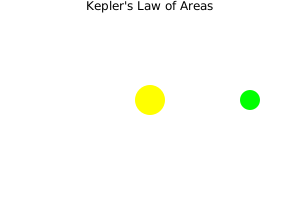
The Law of Equal Areas, formulated by Johannes Kepler, is a pivotal principle in the realm of celestial mechanics. This law states that a line segment joining a planet and the Sun sweeps out equal areas during equal intervals of time.
This law is one of Kepler's three laws of planetary motion and reflects the conservation of angular momentum, providing profound insight into the motion of planets around the sun.
Implications of the Law
Kepler's realization was groundbreaking, helping to improve the heliocentric model of the solar system initially proposed by Copernicus. It led to a deeper understanding of gravity and laid the groundwork for Isaac Newton's theory of gravitation.