The Beauty of Saturn's Rings
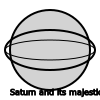
Saturn, the sixth planet from the Sun, is adorned with a marvelous set of rings that have captivated astronomers and space enthusiasts alike. These rings are composed primarily of ice particles, with a smaller amount of rocky debris and dust. The origin of Saturn's rings remains a subject of much intrigue and study.
Discovered in 1610 by Galileo Galilei, Saturn's rings were initially mistaken for moons or other unknown structures. It wasn't until Christiaan Huygens proposed in 1655 that Saturn was surrounded by a thin, flat ring, that the phenomenon began to be understood.
The rings are divided into seven groups, named alphabetically in the order of their discovery: A, B, C, D, E, F, and G. Each ring orbits Saturn at a different distance and is separated by gaps that are either empty or sparsely populated with material.
Interesting Facts
- The rings extend up to 282,000 km from Saturn, but are incredibly thin, with a thickness of about 10 meters in some places.
- While they appear continuous, they are actually made up of countless small particles, each reflecting sunlight.
- The rings are named after classical letters: A, B, C, etc., and they have varying brightness and transparency.