Understanding Quadratic Functions
Quadratic functions are of the form ax² + bx + c = 0. They graph into a shape known as a parabola, which stretches or compresses depending on the coefficient a.
Parabolas have a wide range of applications from physics to engineering. The exploration of their properties, such as vertex, axis of symmetry, and roots, is fundamental.
Graphing Quadratics
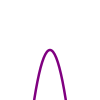
The vertex form of a quadratic function is a powerful tool because it reveals key features of the parabola:
- Vertex: The turning point of the parabola.
- Axis of Symmetry: A vertical line that divides the parabola into two mirror images.
- Roots: The values of x where the parabola intersects the x-axis (can be real or complex).